Choose a Brooklyn Commute That Still Works on a Bad Day
Compare door-to-door time, transfers, accessible paths and backup routes—not just the nearest subway dot on a map.
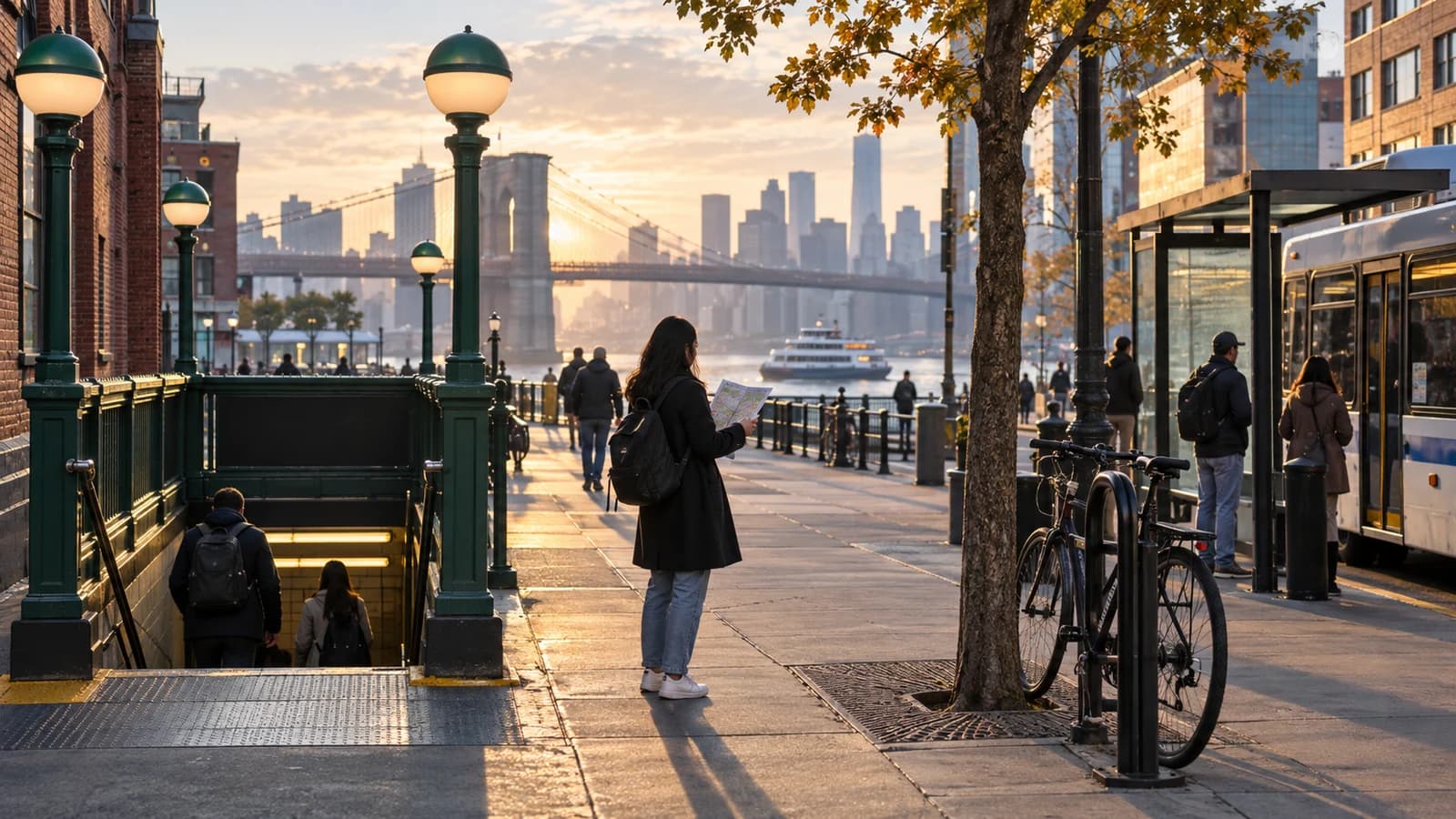
The best commute is the one that remains tolerable when the first route fails. Compare door-to-door time, number and quality of transfers, frequency, walking exposure, accessibility and at least one backup. A nearby station is not automatically useful if it serves the wrong direction, requires an unreliable transfer or cannot meet your mobility needs.
Set the decision before the search
Start with the trips you repeat, not a generalized ride to Manhattan. Map work, school, care, medical and social destinations at their real travel times. Give transfers a cost because a five-minute scheduled connection can become a long wait. Include the walk to the platform, vertical circulation, a bus connection and the final walk at the destination.
Use a written scorecard with the same categories for every address. Mark facts separately from impressions, and date anything that can change. A direct answer is useful only when the assumptions behind it are visible.
Verify the address, not the reputation
Use current MTA planning tools and planned-service notices for each finalist. For an accessible trip, confirm the entire path and current elevator status; an accessible symbol at one station does not make every transfer accessible. Ferry, bike and bus options may be strong backups, but schedules, weather exposure, storage and late-night frequency must match the actual routine.
Keep links to the official pages you used and recheck them when you are ready to sign or move. Service changes, laws, fees, inventory and access conditions are mutable; this article was verified September 26, 2026.
Do the fieldwork
Make the trip during the hour you expect to use it and repeat it once in the opposite direction. Notice crowding, platform navigation, lighting, the wait at transfer points and whether the last bus or walk feels sustainable. If hybrid work is part of the calculation, still test the days and hours you are required to appear.
Write down actual door-to-door minutes and unresolved questions immediately. Memory tends to preserve the attractive kitchen or tree-lined block and discard the inconvenient transfer, stairs or missing errand.
Avoid the shortcut claims
Do not quote a single app estimate as a guaranteed commute. Avoid comparing neighborhoods using different assumptions, such as rush hour for one and midday for another. Express buses, temporary service changes and elevators are operational details to confirm, not evergreen promises. A ferry view is not compensation for a schedule that misses your shift.
Treat any superlative—best, safest, cheapest, easiest—as a prompt to ask who measured it, across what geography and when. The useful outcome is a defensible fit for one household, not a universal Brooklyn ranking.
Make the next move
Score each route on an ordinary day and a disrupted day. Keep the neighborhood with the most resilient acceptable trip, then weigh housing and daily services. The goal is not the shortest possible number; it is a repeatable journey whose weak points you understand.
This page is part of The BK Brief's Living in Brooklyn series. It offers reporting and planning tools, not legal, financial or housing-placement advice. Use the linked agencies and service operators for current rules and individualized help.
Last verified September 26, 2026. Practical details can change; check linked official sources before making plans.